Publications
Publications by categories in reversed chronological order.
2026
- arXiv
 A No-Regret Framework for Adaptive Incentive DesignarXiv preprint, 2026
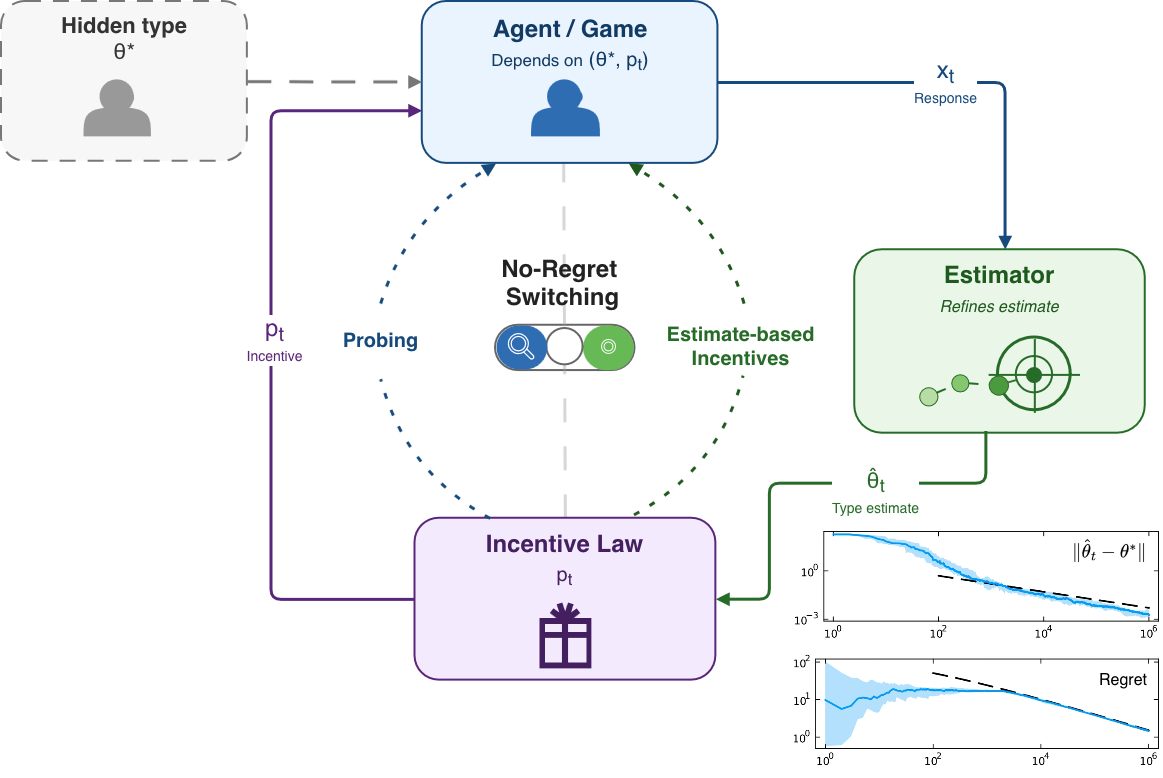
Incentive design studies how a central authority can influence strategic agents through payments, subsidies, or taxes, so that individual objectives align with collective welfare. This paper introduces a No-Regret Adaptive Incentive Design (RAID) framework for nonlinear games with continuous action spaces and private agent costs. In this framework, the authority (planner) designs incentives that regulate the Nash equilibrium toward a socially optimal action profile, while simultaneously learning agents’ unknown preferences from repeated strategic responses. We formulate the RAID problem and construct a least-squares estimator whose strong consistency requires only diminishing excitation. Leveraging this weak excitation requirement, we propose a switching incentive policy that alternates between probing (exploration) and estimate-based (exploitation) incentives. The resulting policy achieves an O(t^-0.5) parameter estimation rate and accumulates O(t^-0.5 \log(t)) squared social-cost regret, almost surely. We further extend the framework to an endogenous-noise response model, where standard least-squares estimation is biased due to an error-in-variables correlation between the noise and agent responses. We utilize a repeated-sampling estimator and corresponding switching policy that retain the same almost-sure convergence and regret rates. Numerical experiments validate the effectiveness and predicted convergence rates of the method.
- arXiv
 Adaptive Incentive Design with Regret MinimizationarXiv preprint, 2026Presented at the 24th European Control Conference, 2026.
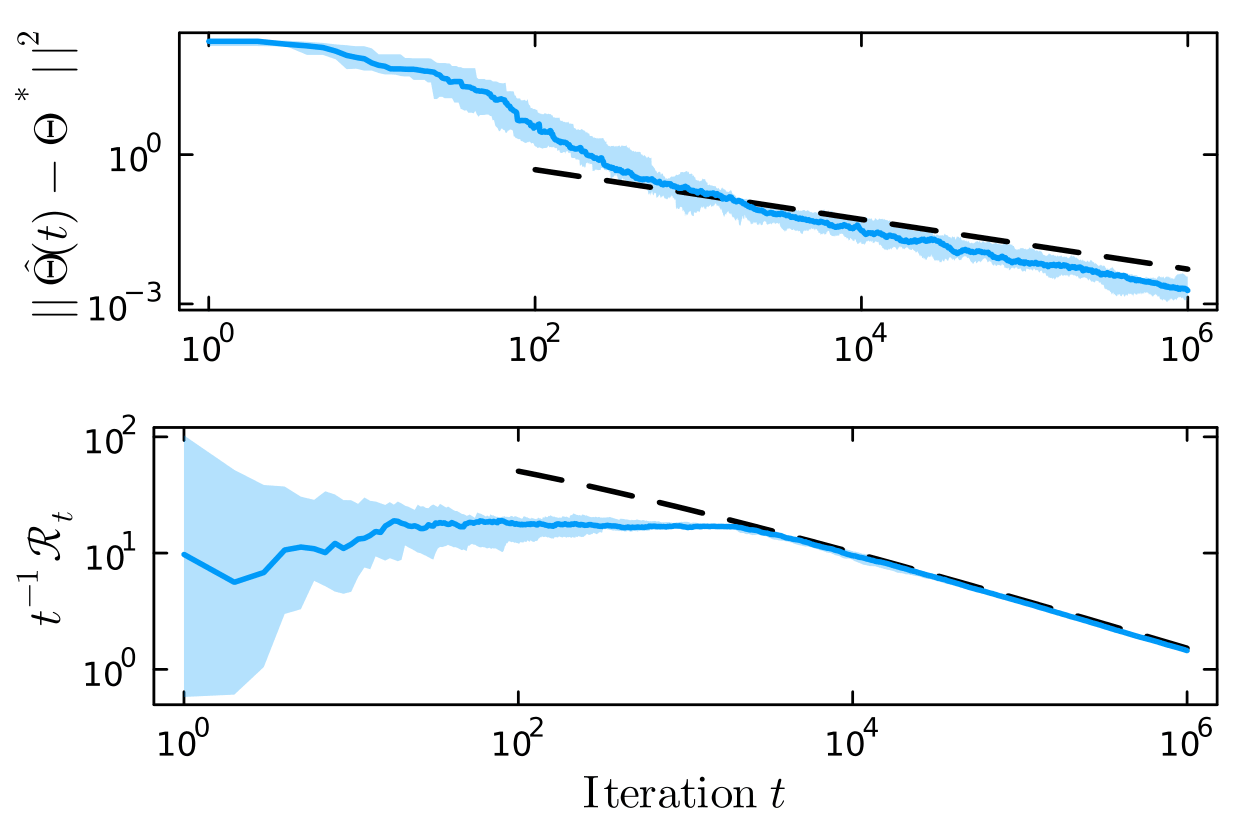
Incentive design constitutes a foundational paradigm for influencing the behavior of strategic agents, wherein a system planner (principal) publicly commits to an incentive mechanism designed to align individual objectives with collective social welfare. This paper introduces the Regret-Minimizing Adaptive Incentive Design (RAID) problem, which aims to synthesize incentive laws under information asymmetry and achieve asymptotically minimal regret compared to an oracle with full information. To this end, we develop the RAID algorithm, which employs a switching policy alternating between probing (exploration) and estimate-based incentivization (exploitation). The associated type estimator relies only on a weaker excitation condition required for strong consistency in least squares estimation, substantially relaxing the persistence-of-excitation assumptions previously used in adaptive incentive design. In addition, we establish the strong consistency of the proposed type estimator and prove that the incentive obtained asymptotically minimizes the planner’s average regret almost surely. Numerical experiments illustrate the convergence rate of the proposed methodology.
- arXiv
 Incentive Design without Hypergradients: A Social-Gradient MethodarXiv preprint, 2026
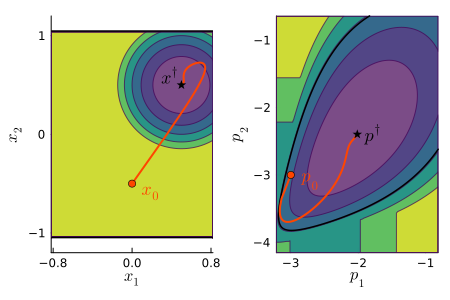
Incentive design problems consider a system planner who steers self-interested agents toward a socially optimal Nash equilibrium by issuing incentives in the presence of information asymmetry, that is, uncertainty about the agents’ cost functions. A common approach formulates the problem as a Mathematical Program with Equilibrium Constraints (MPEC) and optimizes incentives using hypergradients-the total derivatives of the planner’s objective with respect to incentives. However, computing or approximating the hypergradients typically requires full or partial knowledge of equilibrium sensitivities to incentives, which is generally unavailable under information asymmetry. In this paper, we propose a hypergradient-free incentive law, called the social-gradient flow , for incentive design when the planner’s social cost depends on the agents’ joint actions. We prove that the social cost gradient is always a descent direction for the planner’s objective irrespective of the agent cost landscape. In the idealized setting where equilibrium responses are observable, the social-gradient flow converges to the unique socially optimal incentive. When equilibria are not directly observable, the social-gradient flow emerges as the slow-timescale limit of a two-timescale interaction, in which agents’ strategies evolve on a faster timescale. It is established that the joint strategy-incentive dynamics converge to the social optimum for any agent learning rule that asymptotically tracks the equilibrium. Theoretical results are also validated via numerical experiments.